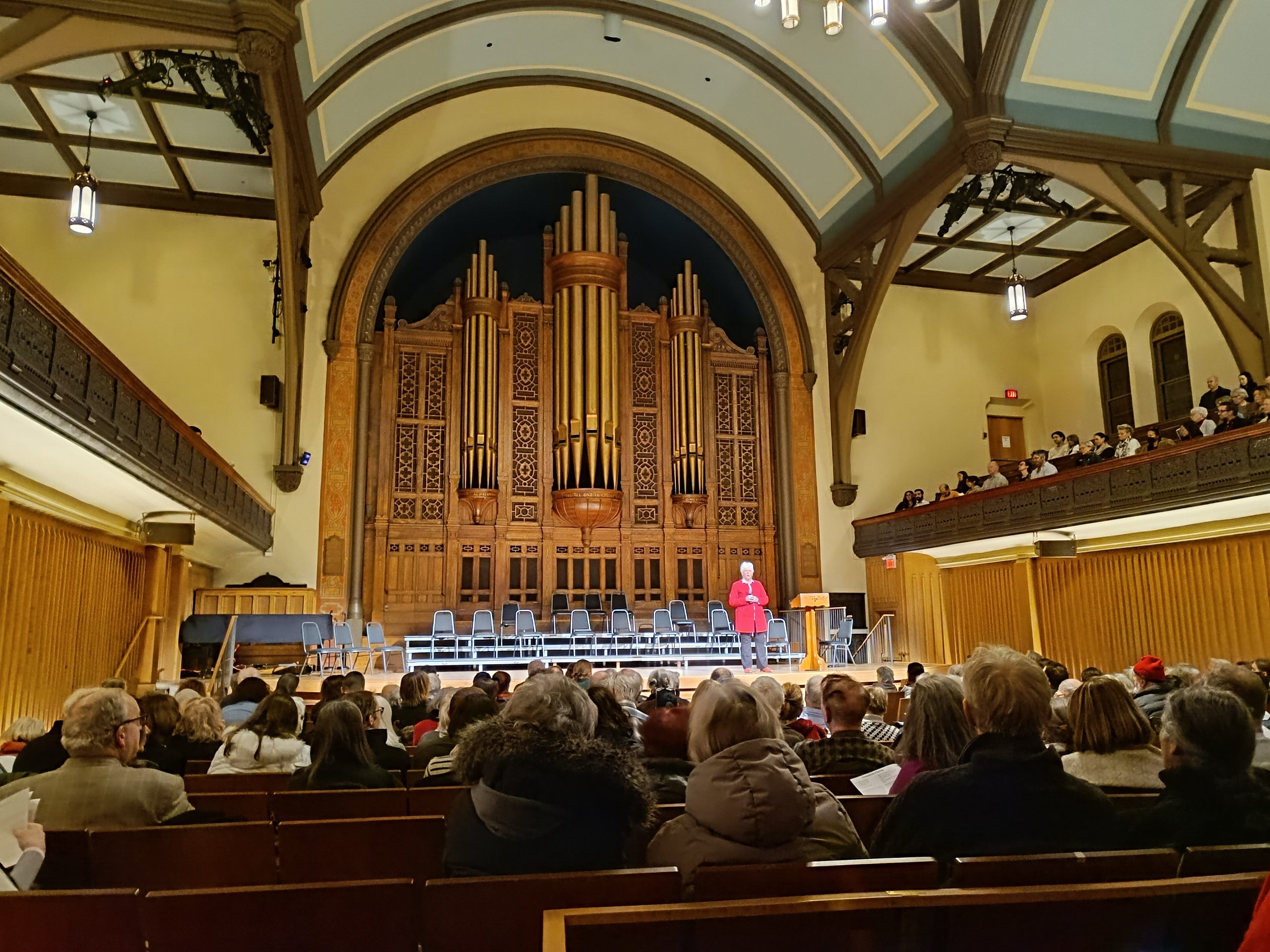
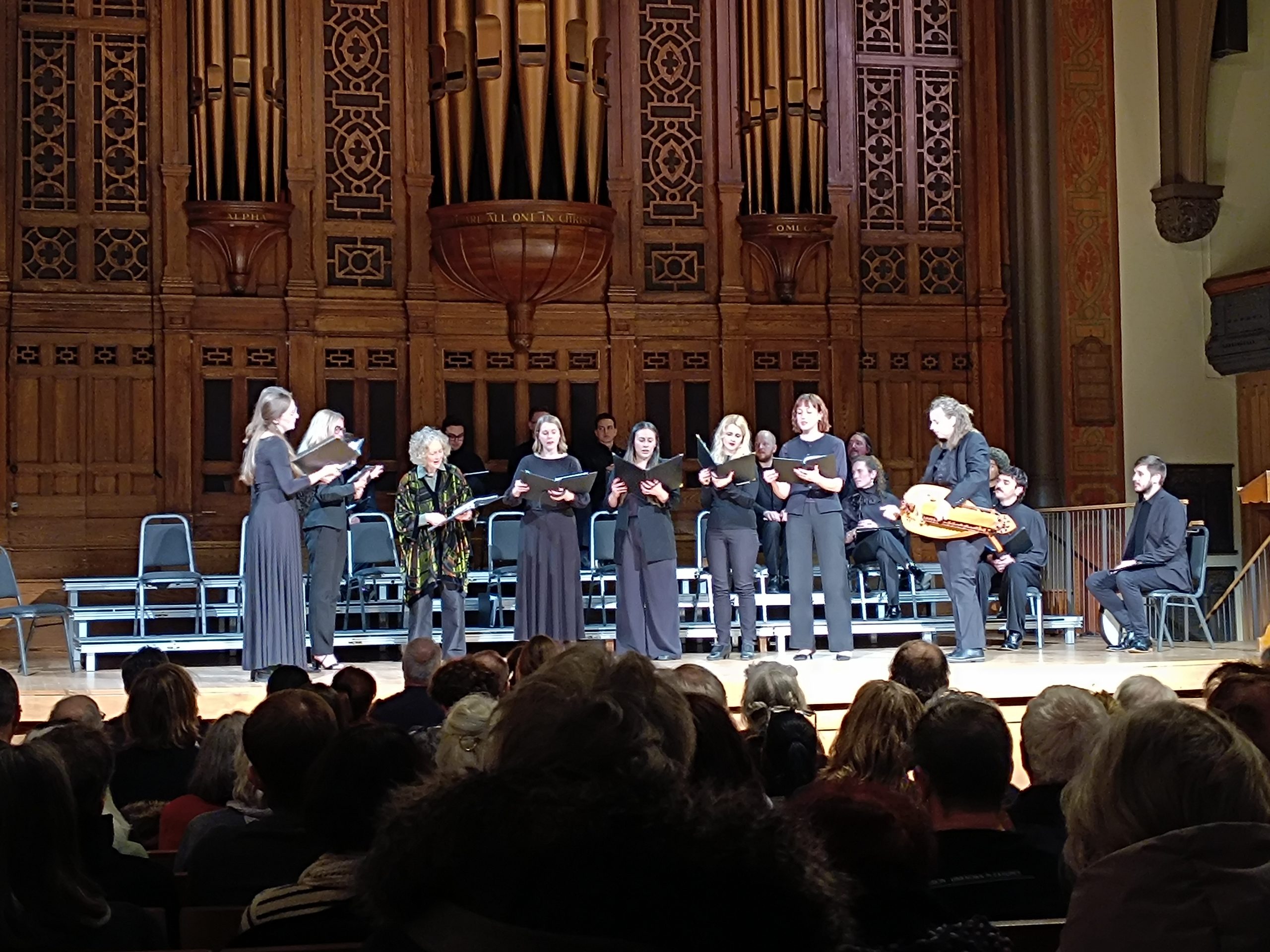
Each of those present felt the mystery and mysticism, the beauty of the sound of Hildegard von Bingen’s music .Her Symphonia armoniae celestium revelationum, featured soaring, mystical chants expressing divine light and cosmic harmony, distinct from Gregorian plainchant, with lyrics praising Mary, saints, and divine wisdom, including the famous morality play Ordo Virtutum, making her one of the earliest known composers with extensive surviving works that blend intense spiritual feeling with unique melodic lines, often linked to her prophetic visions and known to us as best medieval composer.Her melodies — wildly expressive, richly melismatic, and imbued with a profound spiritual imagination — feel timeless, as though she was channeling something far larger than herself.
Hearing this music on the Toronto Consort stage in December 2025 is a huge honor and a huge thank to the team of musicians who worked on the program.
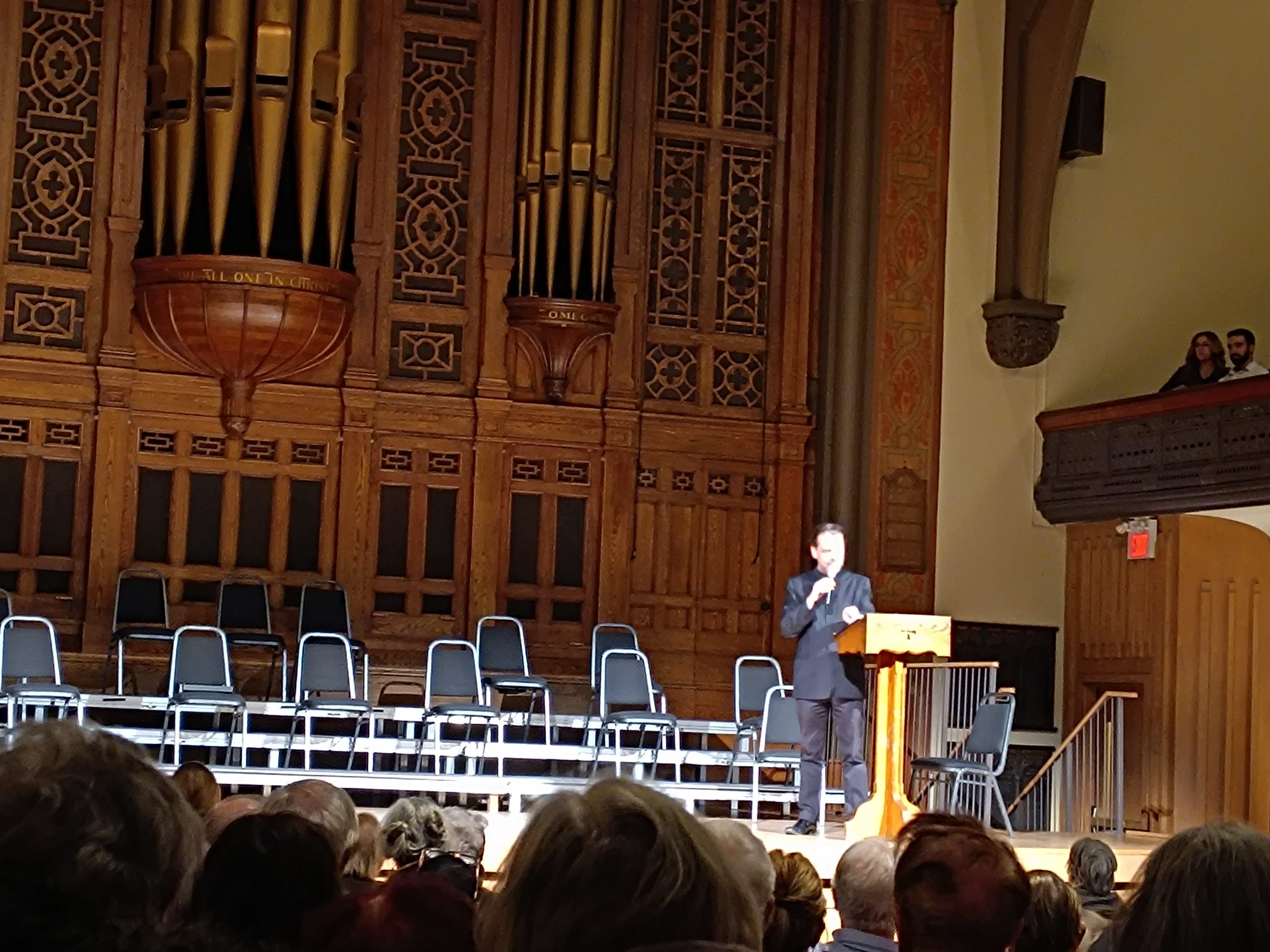
Opening remarks by the President Heather Turnbull
This is monophonic music 12th century,which is imbued with her spiritual vision. These are unique individual musical lines that unite into harmony.
I want to say right away that those who attend and attend the Toronto Consort’s concerts, in all seasons, are fortunate admirers of Renaissance music, which this team of musicians so reverently creates and reproduces for Toronto under the direction of a wonderful, talented conductor Daniel Taylor.
On December 7, Toronto Consort Honorary Patron Dame Emma Kirkby returns to our stage for A Medieval Christmas – A Feather on the Breath of God and Her presence at this concert added a line of continuity between generations, care and love for the admirers of this music, and her singing is a separate admiration.This is a deeply moving Advent concert by the Toronto Consort, led by the legendary Dame Emma Kirkby.
I want to say that being an admirer of this team of musicians, helping them financially, and supporting them is important to preserving the traditions of Renaissance music.
That’s why hearing this a cappella singing is breathtaking, and the choir’s division into two parts and their union during singing is the height of pleasure. The audience feels as if they are drowning in the music, it flows from below and surrounds the hall on all sides.
Following centuries-old traditions and never changing them, Christmas is divided into pre-Christmas and post-Christmas caroling.
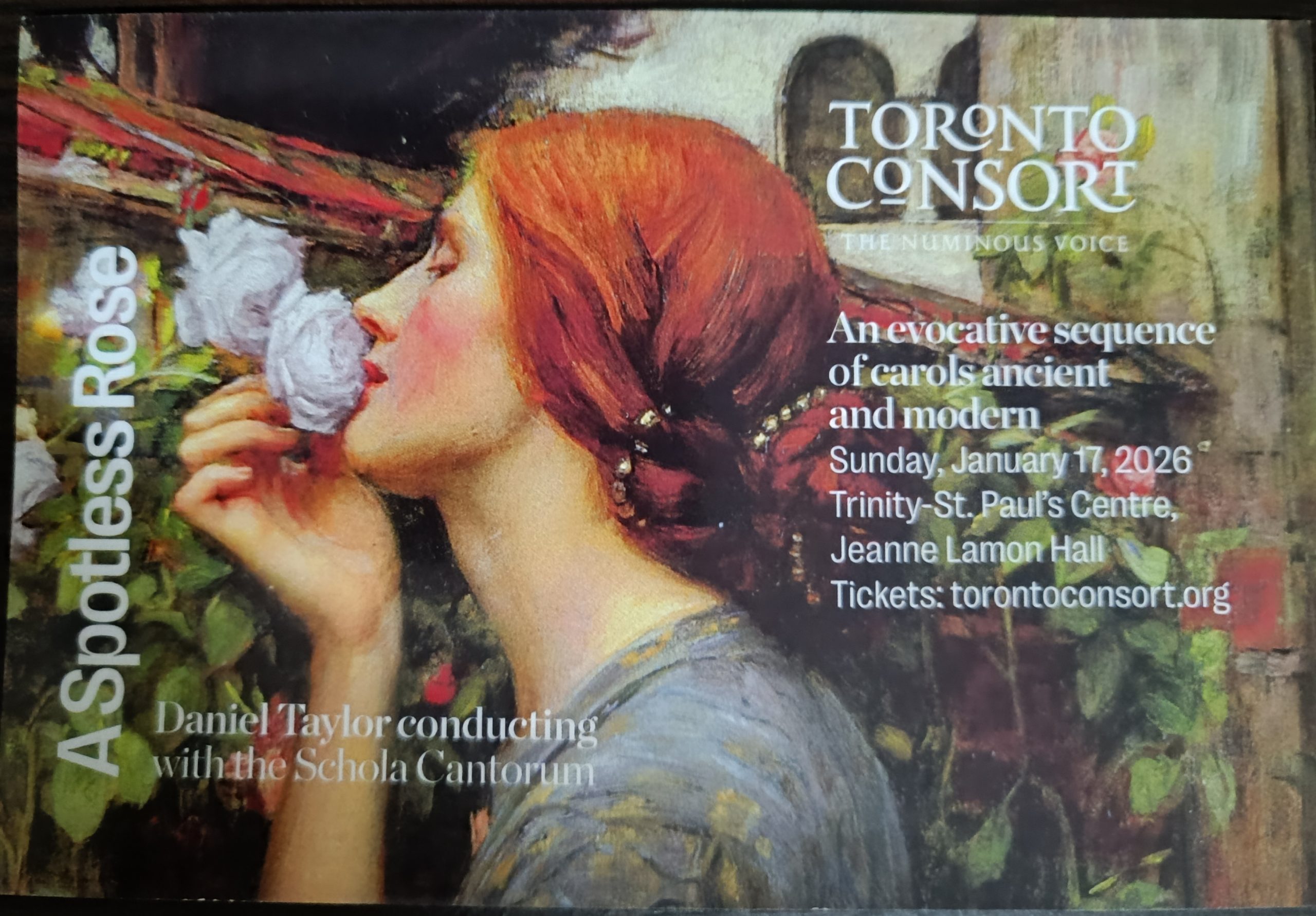
So, another magnificent post-Christmas concert awaits us.
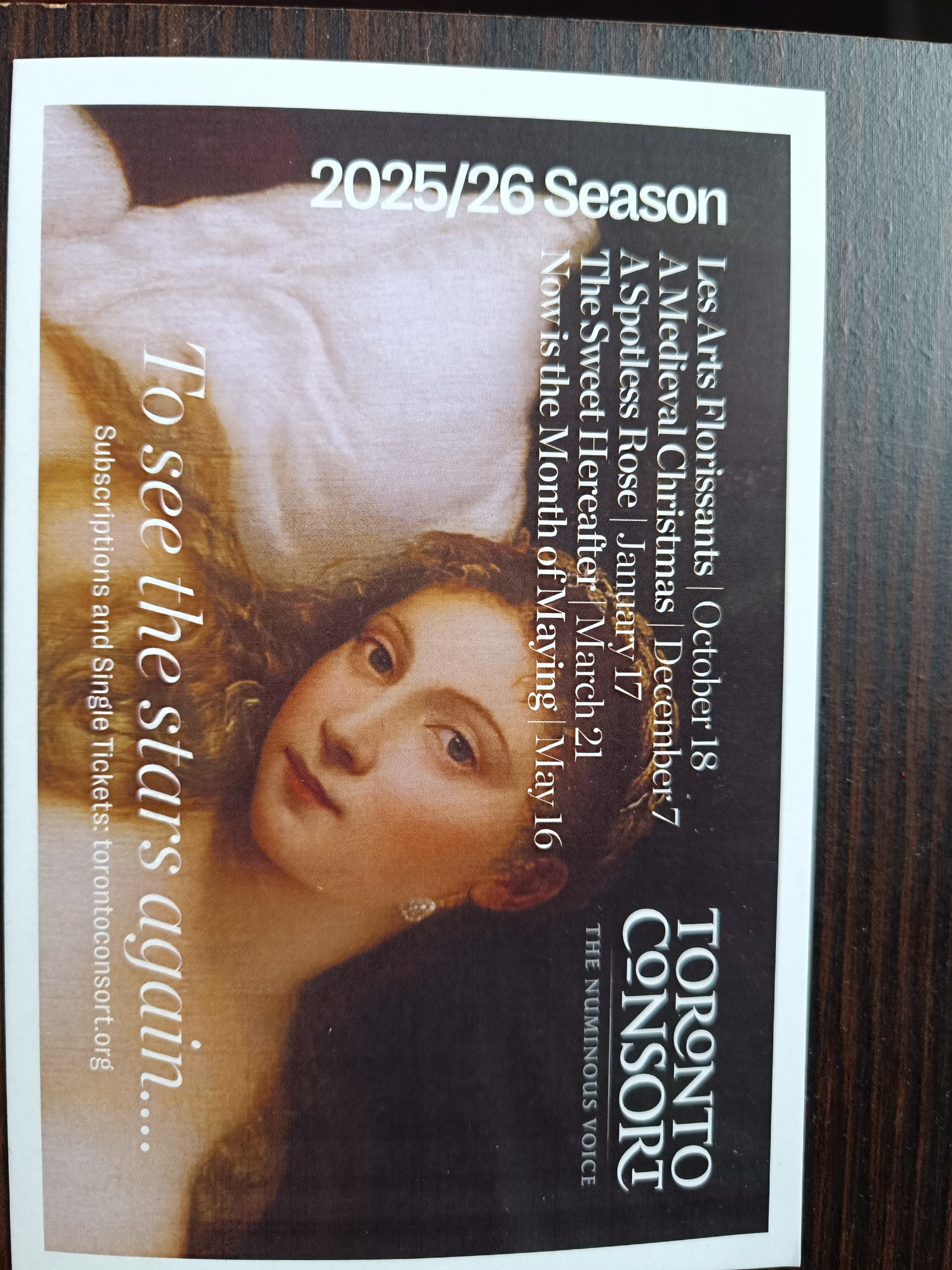
Save the date—January 17, 2026 Trinity-St.Paul’s Centre,Jeanne Lamon Hall
Trinity-St. Paul’s Centre 427 Bloor Street West
,,A spotless rose”
Don’t miss out. I’ll leave you with a list of concerts for next year’s seasons. There are several, but each one is unique. Allow yourself to savor the bliss and experience the splendor of Renaissance music.
When I came home after this unique performance and excitedly began to share my impressions with my husband, he listened attentively, did not interrupt and with his characteristic Eastern wisdom at the end of my story answered:,,This is possible only in Toronto” Well, of course, I fully share his words, but I also have my own additions – such a unique work has survived and today we saw it thanks to The Toronto Consort, people who preserve the oldest works and pass them on to us, revive historical masterpieces, help to see the life of past generations through musical prism.
Thank you Daniel Taylor.
Thank you Emma Kirkby
Thank you for its exellence in the performance of medieval,renaissance and early baroque music.
12th century. Today we will talk about it. What is wonderful and surprising is that literally my previous post talked about the same period, but in Persia, in the East. And today I am publishing about another place – about Europe in the 12th century. Yesterday, somehow I came across my thought that in the 12th century the church was strong over society and dictated its own rules. People were looking for a way out of their life’s troubles and where then they covered themselves with it, somewhere in the opposite direction of the church they acted. In Europe, a cleavage was already coming. (Yesterday I said that the cleavage occurred in the 15th century, and we were just talking and my interlocutor decided to watch it later, whether it was so. It turned out that I was right, in the middle of the 15th century a dissent occurred, which changed the traditional framework of rules, the secession of Catholicism, Orthodoxy.) But let’s still talk about GRIGORIOUS_THE HOLY SINNER himself.
I should retell the plot a little, because no matter how much the woman is the cause of all the misfortunes in this work, Gregorius still remains the main character and the misfortune of the whole story.
A young girl sins with her brother before her wedding. This causes her to become pregnant. She hides the pregnancy and gives birth in complete secrecy in a monastery, after which she goes down the aisle. The child is dressed in silk clothes and sent down the river with God in a small boat with a note. A fisherman finds him, brings him to a church official, who leaves the child, asks the fisherman to raise him and helps raise the child as a servant of God. The mother gets married, but three days after the coronation, her husband and her brother die. She mourns them and buries them. After 17 years (I am interested in this chronology, it is different from ours, I guess) the boy grows up and becomes the main priest in this area. He needs to get married and his wife becomes his… mother (he and she feel some kind of love and closeness)
Being intimate, the mother sees the signs of her son and asks about them, she understands that in front of her is her son and tells him about it. He is confused, depressed and killed. He runs away from her, comes to the fisherman, and decides to go to the hermits, where he spends 17 years in the wild nature (again this date).Gregorius throws the key into the sea and says that when the key is found, he will return (very popular for those times). According to the rules of the time, Paul takes the place of the missing priest and asks three servants to find out and understand what happened to Gregorius.
The messengers come to the fisherman, and the old man treats them to his catch – a big fish. When he cleaned it for them – he found a key in the fish’s belly. It was a sign, and they went to the mountains to look for the hermit. They found him alive, but changed, wild and angry, aggressive. They asked him to come back and showed him the key. They went to the city, carrying the news of the living Gregorius. Three days later the monk returned to the city, which greeted him with greetings, singing and dancing. He returned to the rank of Pope.
His mother came to him, having learned that he was alive. They returned to love, began to live together and even had two heirs.
About the beautiful tales in the form of songs, created in the 12th century.
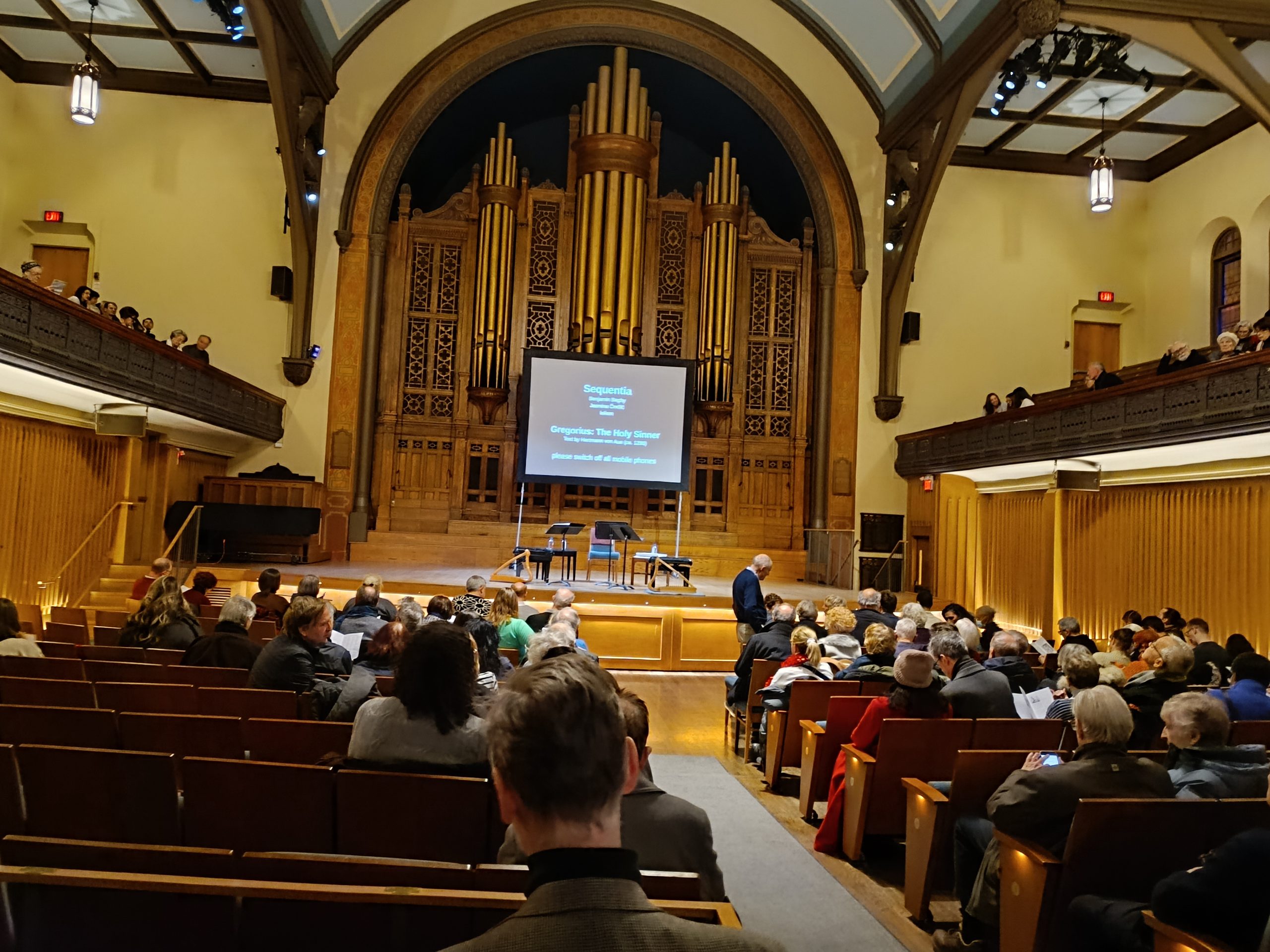
Sequentia-a series of musical narratives performed by three vocal artists @BenjaminBagby ,@jasminaCrncic and @LucasPapenfusscline
The wonderful trio of vocalists performed the story in German and the originality of the performance is a tribute to the work of Benjamin Bagby, who created this kind of innovative musical storytelling and has been transmitting it for almost 50 years since 1977, nurturing a generation of young performers and touring the world. He created more than 30 recordings spanning the entire Middle Ages(including the complete works of Hildegard von Bingen),film and television productions of medieval music drama.Today I am telling you about a work created in the 12th century.
And this kind of work is called medieval theatre and is a genre of mystery, farces and masks, as well as English cyclical dramas.
Medieval theaters originate from the Roman Empire (again Rome, the Roman Empire. How much the Roman Empire gave us – it left its notes, its traces and affected our lives for a long time, although it itself fell apart and today it is no longer there). From the time of the Roman Empire until the 15th century (when a lot changed in Europe, including what I wrote above) The themes of medieval theaters were always religious themes. Modern interpretation or traditions of medieval performances are plays of mummers, which are staged in the USA and Britain. The parade of mummers takes place every New Year in Philadelphia and is considered a folk parade. But as we can see, it is a continuation of the traditions of medieval performances.
Medieval plays also include mysteries, which are often performed in Britain. Our play is an example of a morality play as a types of drama from Middle Ages.
But how can I tell you now or describe everything that happened on stage yesterday – after all, you have to see it and it is so beautiful and refined that everything that I described to you above is very subtly told to us, the spectators in the hall, with the help of the vocalists playing the harps.
A very beautiful combination of musical harmony, playing instruments and narrative performance.
An hour and a half in one breath. And it seems that we know what will happen now, and again a curl and another story that captivates and makes you listen and follow the story.
I consider myself lucky to have listened and been a spectator of this evening.
Before the performance there was a lecture where we were told about Gregorian chant .This knowledge goes deep into the Roman Catholic origins of the church.Greagorian chant is named after St.Gregory I(590-604) it was collected and codified.
Harmonic monophonic texture makes medival music unique.
Have I filled you with intrigue? Whenever possible, when you see posters about medieval performances, go without hesitation and enjoy this performance. I wish you good luck